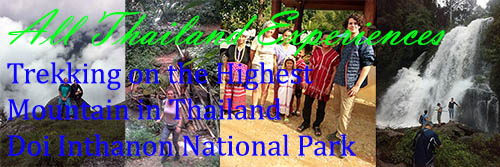
Trekking on the Highest Mountain in Thailand at Doi Inthanon National Park
The best in nature and culture Thailand has to offer
| “An incredible 2 day experience” Rob, Vancouver, Canada“ | “real Thailand -not made up for tourists” Christine, Madrid, Spain |

When it gets too hot to stay in Chiangmai city, no worries, just go to Doi Inthanon National Park a short 90 kilometers away. Bring a jacket, believe it or not, you will need it. We load the pick-up truck and head to the highest mountain in Thailand at Doi Inthanon National Park. The park is very large with no public transportation so if you want to visit the park best to rent a motorbike or better yet take a 2 or 3 day tour or trek.
Before I tell you more about the park I need to mention that I speak Thai and live in Chiang Mai since 1989. I have visited the park hundreds of times through the years. Many in the park do not speak English, their are local guides available but only a few speak English.

My suggestion if you do not speak Thai is to do the 1 or 2 night Home Stay at the home of a local Karen Hill Tribe English Speaking Guide who speaks perfect English. The guides village is away from the normal tourist areas in beautiful setting. As this is a private Home Stay with local Karen hill tribe guide, you will have lots of time to discuss with your guide the local hill tribe life and the surrounding forests. You will meet his family and partake in daily life. Your guide will also discuss with you the different trails and their difficulty and you can then decide which trail to hike and for how long. This can all be discussed with your guide once you arrive at the bungalows in the park. You can then work with your Karen guide picking and roasting coffee, feeding fish at the trout fish farm, learn weaving with a back strap loom, plant or harvest rice in the fields or hike in the forest for 2 to 6 hours with you guide. The itinerary can be changed to meet your desires.
WARNING: If going by motorbike DO NOT rent a automatic transmission motorbike. This is because when you go down the steep hills the automatic motorbike goes into natural. You will not have back pressure from the motor to slow you down and only the brakes will slow you down. Brakes may overheat and fail. Rent a automatic clutch motorbike so you can down shift gears to help slow you down. A Honda Dream or Wave works great.
Soon after entering the park gate, the road climbs steeply through a cutting before leveling out, passing the Doi Inthanon National Park Information Center, overlooking the Mae Klang river on the left. The road passes through open dry forest and after crossing over to the left bank, follows the course of the river, overlooking it. In the dry season, the leaves of the trees become yellow and red, before being shed.
As the road climbs gradually, an evergreen gallery forest begins developing along the banks of the river, supporting many tall and stately trees. Soaring birds of prey can sometimes be seen over the steep ridge on the north side of the road. The more level areas in the vicinity of the river are now cultivated and support small areas of orchard or vegetable gardens. Above Wachirathan waterfall, the road once again crosses over the Mae Klang River and continues to ascend the mountain, following the north bank. The surroundings change very abruptly in character, and pines predominate in many areas.

The next area supports Hmong and Karen villages, there are many government offices and residential buildings, including the headquarters of the National Park and various highway and construction works. Here is where the campsites are but you first must check in at the Park Headquarters. There are also cabins for rent however most are rented well in advance. Here we are above 1500 meters and the temperature is like a beautiful spring day.
Time to find a camping spot. Its lunchtime, so we travel to the Karen hill tribe village area of Baan Mae Klang Luang at the 26 Kilometer road marker Here there are several restaurants and a coffee and waffle shop in a beautiful setting. From here the road winds uphill sharply and past a park checkpoint. Just a little further is a mountain ridge with excellent vistas on both sides of the road. If the weather is clear, at one spot you can see the city of Chiang Mai on your right. Just a little further on your left is the twin Chedi dedicated to the King and Queen. These beautiful Thai structures are a must visit. You will need to walk up several flights of steps to reach them but well worth it.Next stop is the summit. Here we get out of our vehicle and walk up the steps to the shrine dedicated to the Lanna Thai King who first designated this area as a national park. Walk behind the shrine to a concrete pillar and stand on it. You are now on the highest point in Thailand.We departed Chiang Mai at 9 am it was already 35 degrees C. and started the short 1 1/2 hour drive to the park. We left Chiang Mai by highway 108 through Hang Dong and Sanpatong and then about one kilometer before Chom Tong turned right on highway 1009. There is a big sign in English stating “Doi Inthanon” where you turn so it’s easy to find. Continue 8 kilometers to where the road forks and then keep to the right where you will see the park entrance. The entrance fee is 300 baht and they have free maps and information for you that you will need. A copy of the park map can be seen online and might be a useful reference as you read this article.You need to know the park rules that levy stiff fines if broken (such as for picking flowers); these rules are written on the back of all the maps and brochures.A local guide is required for all trails in the park and available at the Gew Mae Pan trail . If you are caught on the trail without a local guide the fine is 2000 Thai baht each.https://www.youtube.com/embed/OQHxiWVtKUY?rel=0After getting all the information we needed we headed straight to Baan Mae Klang Luang at the 26 Kilometer road marker for accommodations reservations where we both noticed a thermometer and found it was a perfect 26 degrees C. We decided to spend our first night in a tent and second night in a bungalow. I wanted to do the Hill Tribe Home Stay but my wife wanted something more comfortable so we stayed in the bungalows. We made our reservations for the bungalow with All Thailand Experience a week ahead of our trip to the park. Since we were going to ride around the park the Coffee and Waffle shop kept our bags for us and we proceeded to the camping area next to a beautiful stream in a garden setting to pitch our tent. Here they have hot showers and toilets close by to use for free Tents can be rented for 200 baht and blankets at 20 baht each.Choice of several bungalows from rice field view to stream side. Each bungalow has 2 queen sized beds, hot shower and western style toilet. 3 bedroom bungalows available.     After putting up the tent we were getting hungry and headed back to see our friend and birding guide Grace and went to eat at a restaurant serving delicious Thai food at great prices near the hydroelectric plant. While having lunch we were told that a 7- man soccer match was being played this afternoon on the soccer field next to the restaurant on the Park Headquarters grounds. The match was between a Karen hill tribe village and a Hmong hill tribe village located in the park so we stayed and watched the action under the shade trees drinking ice-cold beer. We made plans to do some hiking on the Gew Mae Pan Trail near the Doi Inthanon summit (above 2000 meters tomorrow) so today was for relaxing, which I myself am very good at doing.Just before dark we ate our dinner, again at the bungalows at Baan Mae Klang Luang, got our things from the Coffee and Waffle Shop and went to our camp. In May there aren’t many people in the park so a secluded place to put our tent was easy to find. We built a nice campfire and I spent the evening reading while my wife did her crochet. The only sound was that of the crickets and with the smell of pine and clean fresh air drifting off to sleep was a total pleasure I haven’t experienced in many months while living in the crowded city. The next morning we awoke early and packed up the tent and returned to the Coffee and Waffle Shop for a great cup of coffee and delicious waffle and again he kept our bags for us. I checked the thermometer and it was a cool 18 degrees C.The bungalows have a Thai food restaurant, fresh coffee and waffle shop plus a general store for beer and snacks. After putting up the tent we were getting hungry and headed back to see our friend and birding guide Grace and went to eat at a restaurant serving delicious Thai food at great prices near the hydroelectric plant. While having lunch we were told that a 7- man soccer match was being played this afternoon on the soccer field next to the restaurant on the Park Headquarters grounds. The match was between a Karen hill tribe village and a Hmong hill tribe village located in the park so we stayed and watched the action under the shade trees drinking ice-cold beer. We made plans to do some hiking on the Gew Mae Pan Trail near the Doi Inthanon summit (above 2000 meters tomorrow) so today was for relaxing, which I myself am very good at doing.Just before dark we ate our dinner, again at the bungalows at Baan Mae Klang Luang, got our things from the Coffee and Waffle Shop and went to our camp. In May there aren’t many people in the park so a secluded place to put our tent was easy to find. We built a nice campfire and I spent the evening reading while my wife did her crochet. The only sound was that of the crickets and with the smell of pine and clean fresh air drifting off to sleep was a total pleasure I haven’t experienced in many months while living in the crowded city. The next morning we awoke early and packed up the tent and returned to the Coffee and Waffle Shop for a great cup of coffee and delicious waffle and again he kept our bags for us. I checked the thermometer and it was a cool 18 degrees C.The bungalows have a Thai food restaurant, fresh coffee and waffle shop plus a general store for beer and snacks.    We had our breakfast at the Coffee and Waffle Shop at Baan Mae Klang Luang headed toward the summit passing fruit and flower stands owned by Hmong Hilltribe people. Here we stopped to have a look and across the street were green houses filled with beautiful flowers. The growing of flowers is a Royal Project so the hill tribe people can live in harmony with the park’s conservation plans instead of doing their traditional slash and burn farming.The 2.5-kilometer Gew Mae Pan Trail begins about half a kilometer past the twin Chedis at kilometer marker 42. We decided to leave our vehicle at the Chedi and walk the horseshoe shaped trail to the end and return the same way. This turned out to be a good idea as the mountains were covered with mist and clouds and the view although beautiful was limited on our way out. On the way back the clouds had lifted and the view was spectacular.The trail begins through dense forest with lush ferns and moss covering the tree trunks. Wild orchids and colorful birds are plentiful. It’s uphill most of the way, crossing streams and climbing over and ducking under logs. The temperature is perfect for hiking and the sounds of the many birds and creeks are very enjoyable. After about an hour you come upon a clearing looking toward the west. When we arrived clouds were rushing up from the valley floor to meet us. We had our breakfast at the Coffee and Waffle Shop at Baan Mae Klang Luang headed toward the summit passing fruit and flower stands owned by Hmong Hilltribe people. Here we stopped to have a look and across the street were green houses filled with beautiful flowers. The growing of flowers is a Royal Project so the hill tribe people can live in harmony with the park’s conservation plans instead of doing their traditional slash and burn farming.The 2.5-kilometer Gew Mae Pan Trail begins about half a kilometer past the twin Chedis at kilometer marker 42. We decided to leave our vehicle at the Chedi and walk the horseshoe shaped trail to the end and return the same way. This turned out to be a good idea as the mountains were covered with mist and clouds and the view although beautiful was limited on our way out. On the way back the clouds had lifted and the view was spectacular.The trail begins through dense forest with lush ferns and moss covering the tree trunks. Wild orchids and colorful birds are plentiful. It’s uphill most of the way, crossing streams and climbing over and ducking under logs. The temperature is perfect for hiking and the sounds of the many birds and creeks are very enjoyable. After about an hour you come upon a clearing looking toward the west. When we arrived clouds were rushing up from the valley floor to meet us.  The next portion of the trail is through dense forest again crossing several streams. The park has provided small bridges to make crossing the streams easy. The last part of the trail is through a lovely evergreen forest with pine trees much different and larger than those found at our campsite.We returned the way we came following the trail to the clearing and this time the clouds had lifted leaving a spectacular view of the valley floor and surrounding mountains. Two hawks were circling above, diving to the valley floor then lifting again on the air currents along the cliff edge, their screeching echoing through the canyon below.We spent a total of six hours on the trail and saw only two other people. They were Thai photographers doing a story for a nature magazine. We could have stayed longer but hunger was setting in so we returned to the restaurant at the Baan Mae Klang Bungalows.This evening was spent in our comfortable bungalow. We made reservations the day before. The bungalow has electricity and is equipped with a king size bed in the bedroom and a single bed with table and chairs on the porch. It has simple bathroom with shower and western style toilet.The next day we spent visiting the many waterfalls in the park. The first one was very close to our bungalow and actually two waterfalls named after the King and Queen and called Siriphum waterfalls. The next two waterfalls were also close together and the road getting there was a little difficult but worth the effort. We went just past the second check point at kilometer marker 38 and turned left toward Mae Chaem and traveled about 8 kilometers. Here there is a sign where you turn right and travel the dirt road for 2 kilometers to the ranger station. From there it’s a 500-meter walk to Mae Pan waterfall and 200 meters to Huai Luaeng waterfall.Forest hike at Doi Inthanon Nationap Park video The next portion of the trail is through dense forest again crossing several streams. The park has provided small bridges to make crossing the streams easy. The last part of the trail is through a lovely evergreen forest with pine trees much different and larger than those found at our campsite.We returned the way we came following the trail to the clearing and this time the clouds had lifted leaving a spectacular view of the valley floor and surrounding mountains. Two hawks were circling above, diving to the valley floor then lifting again on the air currents along the cliff edge, their screeching echoing through the canyon below.We spent a total of six hours on the trail and saw only two other people. They were Thai photographers doing a story for a nature magazine. We could have stayed longer but hunger was setting in so we returned to the restaurant at the Baan Mae Klang Bungalows.This evening was spent in our comfortable bungalow. We made reservations the day before. The bungalow has electricity and is equipped with a king size bed in the bedroom and a single bed with table and chairs on the porch. It has simple bathroom with shower and western style toilet.The next day we spent visiting the many waterfalls in the park. The first one was very close to our bungalow and actually two waterfalls named after the King and Queen and called Siriphum waterfalls. The next two waterfalls were also close together and the road getting there was a little difficult but worth the effort. We went just past the second check point at kilometer marker 38 and turned left toward Mae Chaem and traveled about 8 kilometers. Here there is a sign where you turn right and travel the dirt road for 2 kilometers to the ranger station. From there it’s a 500-meter walk to Mae Pan waterfall and 200 meters to Huai Luaeng waterfall.Forest hike at Doi Inthanon Nationap Park videohttps://www.youtube.com/embed/Gg_l33pe3tw?rel=0Our last stop was on the way out of the park at Mae Ya waterfall. To get there you need to go back to Cham Tong and just before you get to highway 108 you will see the sign Mae Ya waterfall. Follow the signs for about 14 kilometers from here. There will be a checkpoint where they collect a 200 baht fee to enter. Just tell them you have been staying in the park and show them the receipt and they will let you in for free. This waterfall is great for photographs and over 250 meters tall. Try to go on a weekday, as the weekends are very crowded with Thais picnicking and swimming.We had a great time although we didn’t see everything such as Brichinda cave. We would also like to spend some time bird watching. The Park staff was a great help and very friendly and I would recommend this trip to anyone.Karen hill tribe villagers geting the rice fields ready for planting video https://www.youtube.com/embed/tX4V1LICfU0?rel=0 |
Copyright & copy; 1997-2019 All Thailand Experiences. All rights reserved.
Please report technical problems to info@all-thailand-exp.com
This page was last modified on: 01/16/2020 05:33:16





 All Thailand Experiences